






Tiles Hop Music & Ball Game review
 Analysis by GetAllApps
The first thing I notice in Tiles Hop is how little separates me from the action: a ball, a sequence of tiles, and a song that gives each move its timing. I guide the ball from tile to tile, trying to keep it moving with the beat. A successful landing feels immediate; a missed tile ends the run and sends me back to try again. That quick cycle is the game’s main appeal, and it makes Tiles Hop Music & Ball Game easy to pick up when I have a spare moment.
One tap turns a song into a challenge
This is a music game rather than a traditional piano-tile game: I’m steering a bouncing ball across a path, not simply tapping keys in a fixed lane. The task is to follow the changing arrangement of tiles while listening for the beat. That combination makes the controls feel simple at first but gives the music a practical role: it helps me anticipate when to move, rather than serving as background decoration.
The developer is AMANOTES PTE. LTD., and the game has grown into a familiar choice for people who want a short, hands-on music challenge. Its audience is reflected in its reach: it has more than 500 million installs, and its average rating is 4.3 from around 3.4 million ratings. Those figures tell me it is widely tried, but the real question for a new player is whether this particular steering-and-rhythm loop suits them.
In my experience, it suits someone who likes quick retries and can enjoy improving by feel. It asks for attention, but not the long commitment of a campaign or a complicated rhythm-game setup. I can start a run, focus on the next few landings, and stop when I’m ready. That makes it a natural fit for a short break, a wait in line, or a quiet moment when I want something more engaging than passively playing music.
Why listening matters as much as watching
The most useful adjustment I make is to stop staring only at the ball. Watching the upcoming path helps, but the beat gives me another cue for when to move. If I react to every visual change at the last instant, my steering can feel panicked; if I listen and watch together, the movement becomes more deliberate. This is a small but meaningful change in approach, especially when a run starts to feel faster or less forgiving.
That does not mean the music will automatically make every section easy. The tiles still demand accurate movement, and a player who wants to relax without concentrating may find the challenge interrupts the song. I see the audio and the path as partners: the track supplies a pulse, while the layout determines where I need to guide the ball. When those cues click together, a successful stretch feels earned rather than random.
How the feedback keeps a run moving
Each landing gives me a clear moment of confirmation: I made the move, stayed on the path, and can focus on what comes next. A miss is just as direct. The run stops, and there is no need to wonder whether I completed a complicated chain of actions incorrectly. This clean feedback is one reason the game is approachable, even though accurate timing takes practice.
The trade-off is that a mistake can feel abrupt. If I’m invested in a good run, losing momentum can be frustrating, especially when I know the error came from a small late adjustment. I find it helps to treat a failed attempt as information: was I watching the ball rather than the route, or did I rush because I stopped following the beat? That quick self-check gives the next try a purpose instead of turning retries into automatic repetition.
For a realistic everyday use, I might open it during a short break and play until I complete a satisfying run or notice my attention slipping. The game’s brief action makes that practical, but the same design can tempt me to try again after a failure. If I have only a minute and need to stop immediately, the restart-friendly loop is convenient; if I’m trying to avoid losing track of time, I should decide on a stopping point before I begin.
What counts as a reward
The most dependable reward is the feeling of getting farther through a run or handling a tricky sequence more cleanly than before. The game’s satisfaction comes from execution: I listen, read the path, make a move, and see whether it worked. That is a different kind of payoff from a music app that simply lets me choose a song and listen, or a rhythm game built around tapping a stream of notes. Here, the ball’s route is the challenge, and my attention is split between sound and movement.
I would choose this over a passive playlist when I want to interact with the music, and over a more elaborate rhythm game when I want something that feels direct rather than demanding a deep menu or lengthy session. But if my main goal is to practise instrument technique, learn a song, or enjoy music without interruptions, this is not the better choice. It turns listening into a test of timing and steering; it does not replace a music player or a music-learning tool.
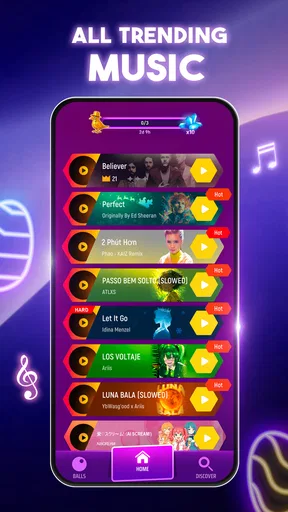
There are in-app purchases, priced from $0.99 to $49.99 per item, while the game itself is free to download. I’d keep that distinction in mind before handing a phone to a child or letting a younger player browse purchase options. The content rating is Everyone 10+, so it is intended for that age range and older. The purchase range also means I would check the app store’s purchase controls if accidental spending is a concern.
Making retries useful instead of frustrating
One practical habit is to use a failed run to identify a single adjustment rather than trying to change everything at once. I might focus on anticipating the next landing, then on keeping my eyes farther along the tile path, while still letting the beat guide my timing. This turns a restart into a small experiment. It is more useful than repeating the same rushed movement and hoping the next attempt goes better.
Another useful choice is to play when I can give the game my full attention. Because the central task depends on watching a moving path and responding in time, it is a poor fit for playing while walking, crossing a street, or doing anything else that needs visual focus. Even in a safe setting, interruptions can break the rhythm and make a run feel harder than it needs to. A seated pause is a better match than trying to squeeze in distracted play.
The interface and basic premise are easy to understand, but that simplicity should not be mistaken for a guaranteed win. The challenge comes from consistent control, and a player who dislikes repeating short attempts may decide the loop is too insistent. I also would not recommend it to someone who wants every music game to reward note accuracy in the same way as a conventional rhythm lane. Tiles Hop is built around guiding a ball across tiles, so its physical-feeling movement is central to whether it clicks.
Who should start, and who should pass
I’d recommend it to casual players who like music, quick reflex challenges, and the satisfaction of getting a little more consistent through repetition. It is also a reasonable pick for someone curious about rhythm games but not ready to learn a dense set of controls. A new player can understand the basic goal quickly, then decide whether the timing and steering are enjoyable enough to keep practising.
I’d suggest looking elsewhere if you want a calm listening experience, a long story, or a music game where progress does not repeatedly depend on accurate movement. It may also frustrate someone who dislikes restarting after a mistake or who prefers to plan a move well ahead without reacting to an evolving path. Those are not minor preferences here; they go directly to the game’s central loop.
The game is free, and its current version is 8.18.1. It was released on January 16, 2018, and requires Android 7.0 or later. I mention those details because they help with the basic download decision, but they don’t change the main advice: the best way to judge it is to see whether the ball-and-beat interaction feels satisfying to you. A large player base may make it easy to recognize, but personal tolerance for retries matters more than popularity.
The loop verdict: one more run, for a reason
The sequence is easy to describe: I steer toward a tile, listen for timing, get a clear landing or a miss, then decide whether to try again. The reward is a cleaner run and the feeling that my attention is lining up with the music. A reset is quick enough to make another attempt tempting, but it is most satisfying when I can name what I want to do differently. That action-feedback-reward-reset cycle is the game’s strongest feature and its main limitation.
Overall, I find Tiles Hop best as a compact, active music game rather than a substitute for listening or a deep rhythm experience. I’d recommend trying it if you like immediate feedback and don’t mind learning through repeated attempts. I’d skip it if a sudden failure would spoil the session or if I wanted music to stay in the background. For the right player, another run begins not just because the game restarts quickly, but because the next attempt offers a clear chance to time a move better.
Pros and cons
Pros
- One-finger controls make the game easy to pick up.
- Short stages suit quick play sessions.
- A range of music styles keeps the soundtrack varied.
- Unlockable balls add a simple collection goal.
- Offline play lets you enjoy stages without internet access.
Cons
- Ads may interrupt play between stages.
- Some songs and content require in-app purchases.
- Precise timing can be difficult on smaller screens.
- Repeated patterns may feel familiar after long sessions.
- A dropped connection can affect access to online features.


